
If you want the best number, you need more than a boat blue book screenshot and hope. This guide shows how to get the best price for my yacht by building a pricing corridor from real comps, using boat values tools correctly, preparing the yacht in ways that pay back, and negotiating without giving the deal away. It also reflects how a boutique brokerage like Aspire Yacht Sales approaches pricing: calm, fact-based, and detail-first.
How to get the best price for my yacht
If you came here to search for how to get the best price for my yacht, you’re already ahead of most sellers. Most owners do the opposite. They pick a number that feels right, list it, then watch the listing sit while buyers circle like sharks at a chum line.
The best price rarely comes from a single perfect figure. It comes from a sequence of smart choices that reduce buyer risk and raise buyer confidence, two things that directly protect your asking price.
Here’s how it works. To get the best price, you don’t chase the highest headline number. You build a price that looks justified, then you back it up with conditions, records, and a clean transaction path. Buyers pay more when they don’t smell trouble.
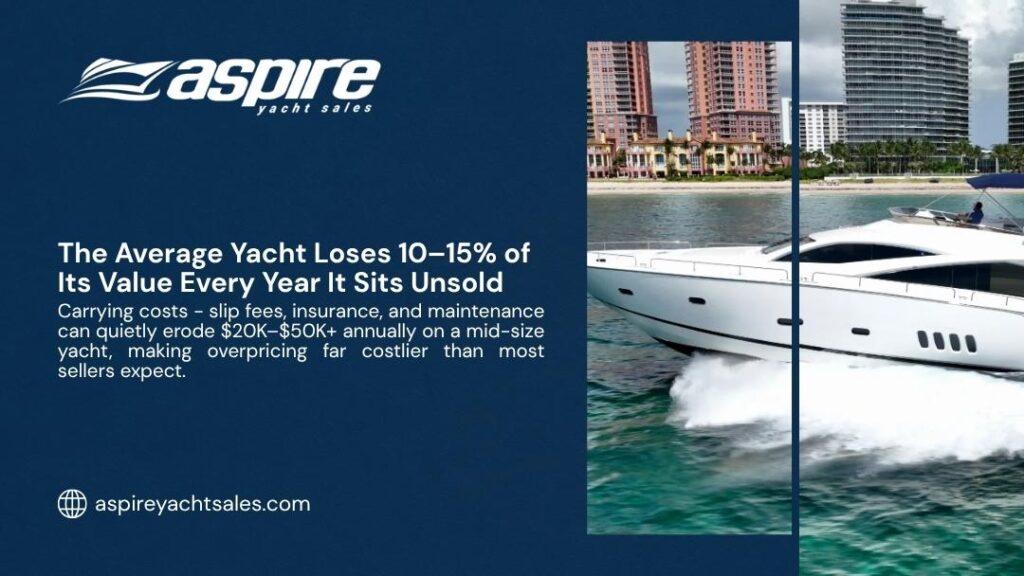
A useful mindset: the best price is the highest price a qualified buyer will pay without you gambling months of carrying costs, slip fees, insurance, maintenance, and the slow drip of market fatigue. Time on the market can stretch long, and boats that linger often sell far below their first ask. That gap is the penalty for mispricing and weak preparation.
The simple truth about the best price.
When sellers say they want top dollar, they usually mean they want the market to reward the boat they remember, not the boat that sits in front of today’s buyer. Buyers, meanwhile, price in uncertainty. Unknown maintenance history equals a discount. Vague listing details equal a discount. We’ll find the paperwork later, which equals a bigger discount.
So, how to get the best price for my yacht comes down to one theme: remove uncertainty before the buyer demands you pay for it.
A 3-number target that keeps you honest
Instead of one price, set three. This keeps your strategy stable even when emotions run hot.
| Your price target | What it means | Who it attracts | What can go wrong |
| Reach Price | The high end that still has logic behind it | Buyers who want the “right” boat and accept a premium for clarity | Too high and you lose early momentum |
| Market Price | The sweet spot where serious buyers engage fast | Qualified buyers who compare comps and act | If the condition doesn’t match, buyers cut hard |
| Exit Price | Your “no-regrets” number | Buyers are ready to close if the risk stays low | If you start here, you may leave money behind |
This is the backbone of how to get the best price for my yacht without turning your sale into a slow-motion headache.
What is my boat worth in 2026?
Before you price anything, you need to answer the question that every buyer asks in their head: What is my boat worth compared to the alternatives they can see in ten seconds?
In the U.S. market, pre-owned dominates. NMMA reports that pre-owned sales totaled 858,798 boats in 2024, representing 78.3% of all transactions, compared with 21.7% for new boat sales. Translation: buyers have options, lots of them, and your price competes against a deep used market.
So if you want to know how to get the best price for my yacht, start by learning how buyers check you.
Boat values vs sold prices (why owners get misled)
Most sellers stare at asking prices. Smart sellers chase sold boats data. Asking prices are marketing. Sold prices are reality. A yacht can list at $X for a year and still close at $X minus a painful discount once survey results arrive or the seller gets tired.
That’s why boat values tools, and boat value guide ranges matter, but only as guardrails. Your real price lives where condition, location, and demand meet.
Valuation tools owners actually use (and how to read them)
Owners often search for NADA boat values, boat blue book, Kelley Blue Book boats, boat value calculator, boat value lookup, or even what’s my boat worth, and hope the internet hands them a clean number. You can use tools, sure. Just don’t let a tool replace market judgment.
Industry guide points out a common-sense process: start with an online valuation estimate, then refine based on age, condition, equipment, and comps, and consider a surveyor for accuracy. The platform also pushes sellers toward its Price Checker tool as a way to determine boat market values and price ranges.
And for the industry’s old-school reference, BUC states its used boat price guides have served as a standard reference for used boat values for decades and include condition and equipment scales, not just a raw number. Here’s what that means in practice.
| Tool type buyers/sellers reference | What it’s good for | Where it fails sellers | How to use it to get the best price |
| “Book value” style guides (boat blue book value, boat value guide, BUC-style references) | Baseline ranges and adjustment logic | Can lag fast local shifts; can’t see your exact refit quality | Use as a sanity check, not the final number |
| Marketplace data tools ( price checker, listing comps) | Real-time market feel and location effects | Asking prices ≠ sold prices | Use to set your Market Price corridor |
| General valuation sources (what is my boat worth guides) | Clear framework for refining value | Still needs comps and condition proof | Use as a checklist for what buyers price in |
And yes, people ask: Is there a Kelley Blue Book for boats? In practice, boaters use a mix of marketplace comps, valuation services, and marine appraisal inputs rather than one universal KBB-style authority. That question matters because it reveals what the buyer expects: a defensible number, not a guess.
The comps method that beats any book value
If you want to know how to get the best price for my yacht, stop being wishy-washy and start being a plan, build comps like a pro.
Comparable does not mean the same brand. Comparable means the same buyer. Match the factors that make a buyer choose one boat over another: length, layout, propulsion, hours, condition, refit proof, and where the boat sits.
| Comp factor | What buyers assume | What you must show to protect the price |
| Engine hours and service | High hours = future cost | Logs, invoices, clear intervals |
| Refit/upgrades | Claims are cheap | Receipts, dates, photos, vendors |
| Location | Some markets pay more | Proof of demand, not vibes |
| Clean documentation | Missing docs = risk | Title/registration readiness and lien clarity |
Do this well, and how much is my boat worth? stops being a nervous question and becomes a confident number.
How to price a boat to sell without leaving money on the table
This is the point where sellers either win big or quietly donate tens of thousands to the market. A selling guide stresses that sellers should decide their rock-bottom price before they list, so negotiations don’t push them into regret. That’s correct, but incomplete. The bigger truth is that pricing is not a one-time event. It’s a launch strategy.
If you want to know how to get the best price for my yacht, you want the market’s strongest attention early, while your listing feels fresh and buyers assume you still have options.
Launch price strategy (first 30 days matter)
In most markets, the first month sets the tone. Buyers who track listings notice new inventory fast. If your first ask looks out of line, you don’t just lose one buyer, you lose the buyer’s agent, the captain friend they text, and the let’s wait for the price drop crowd that forms behind them.
This is why pricing my boat to sell and how to price a boat for sale often emphasizes realism. But realism doesn’t mean cheap. It means defensible. A clean approach: price near the top of your Market Price corridor, then justify it with evidence. The yacht should read like a known quantity.
Price anchors, psychology, and offer padding
Sellers often pad the price for negotiation. That can help, but only if your list price still lands within the buyer’s expectation range. Once you overshoot that range, buyers don’t negotiate; they ignore.
Pricing analysis highlights how pricing relates to speed of sale and the ongoing costs of keeping a boat on the market. Overpricing can cost you twice, first in time, then in forced discounting.
When to reduce the price and how much
Price cuts should follow signals, not panic. A calm seller watches inquiry quality, showing requests, and feedback themes. If you get clicks but no calls, price and presentation mismatch. If you get calls but no offers, survey anxiety or documentation gaps often sit underneath.
If you want to know how to get the best price for my yacht, you want to avoid repeated small cuts that make you look desperate. One thoughtful correction beats three drip reductions that train buyers to wait you out.
Prep that raises the price (and prep that wastes cash)
Owners love spending on shiny upgrades right before a sale. Buyers love ignoring those upgrades and still negotiating. That’s the game. Your job is to spend on what buyers can trust.
Condition and credibility: records beat cosmetics
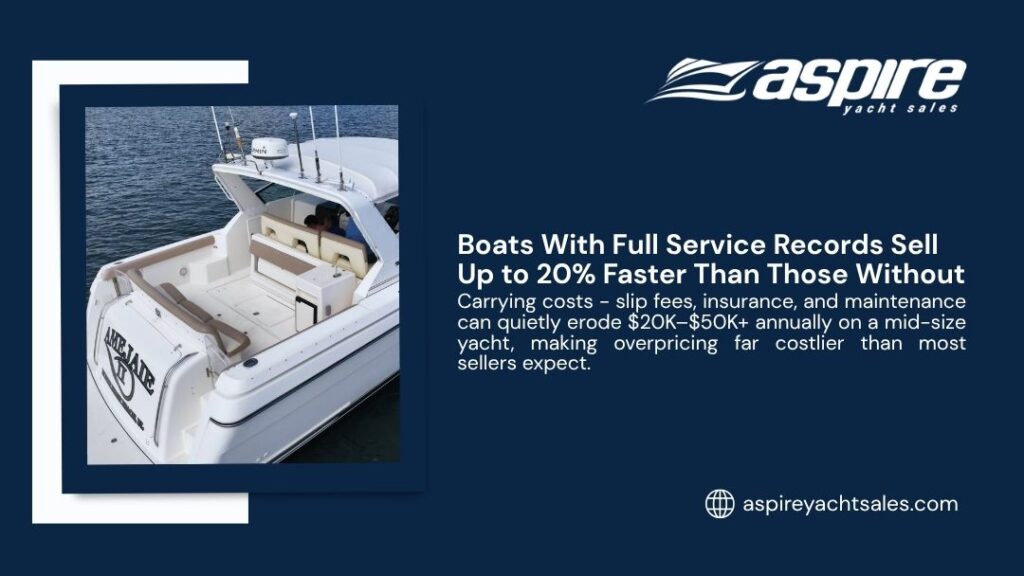
Fresh details and clean cushions help. But the real value lies in credibility. A buyer who believes your maintenance story will pay closer to your ask because the buyer feels less exposed.
For Aspire’s style, boutique, captain-led, detail-first, this is exactly the point. You’re not selling a photo. You’re selling certainty. If you want a realistic what is my boat worth to sell number, present the boat as a known asset, not a mystery.
Survey strategy: pre-sale clarity vs buyer survey drama
Buyers expect a survey. You can either let the buyer control the narrative or you can show that you take the condition seriously.
Marine survey pricing varies by size and scope. Many surveyors price per foot, with examples from established surveyor rate sheets in the rough neighborhood of the mid-$20s to $30 per foot for pre-purchase work, plus minimums and travel.
You don’t cite survey costs to impress anyone. You cite it because buyers use survey outcomes to demand credits. Your defense is documentation, proactive fixes that matter, and the confidence to negotiate from facts.
Listing presentation: the first-click problem
Your listing competes against dozens of alternatives. Premium brokers stress preparation and marketing for a reason: weak visuals and vague copy cost you money, full stop. The brokerage’s sale guidance emphasizes preparation and strategic marketing as central steps in the process.
If you want to know how to get the best price for my yacht, you need a listing that makes a buyer think, This seller has their act together.
Marketing and exposure that bring higher offers
More exposure doesn’t automatically produce a better price. Better exposure does. You want qualified buyers, not tourists. Boat marketplaces remain a major discovery path for high-intent shoppers. The platform positions itself as a leading marketplace for yacht sales and encourages sellers to price their vessels realistically to achieve top dollar.
In practice, that means your listing must show up cleanly in filtered searches: brand, model, length, year, price band, and location. If your listing fails there, it doesn’t matter how great the yacht is.
This can help you avoid the trap where owners say, I listed it everywhere, when what they really did was post inconsistent info with weak photography. If you’re selling with a boutique brokerage approach, it’s also smart to show buyers breadth, what else exists, what the market looks like, and why your yacht is priced where it is.
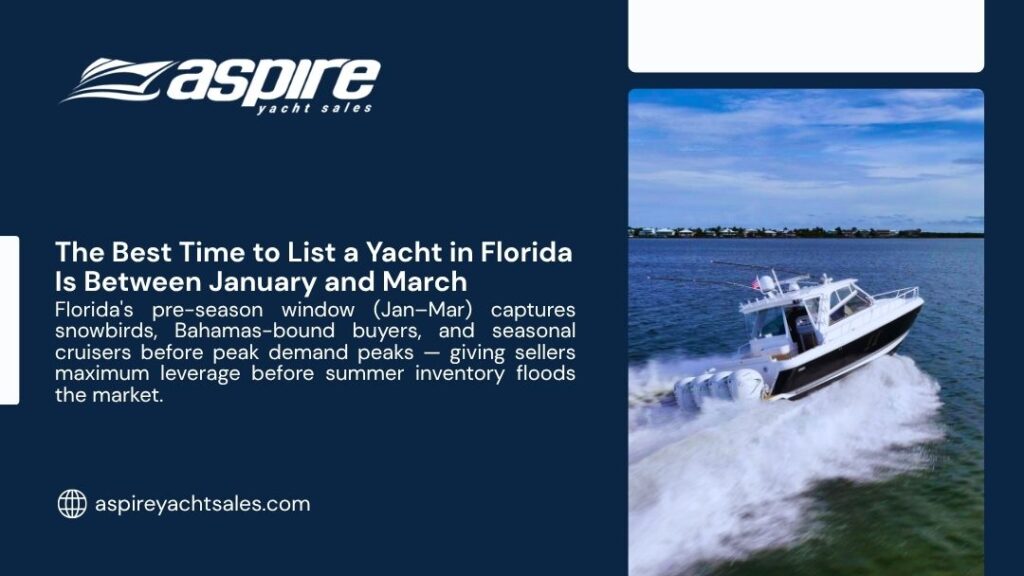
Now, the seller’s side. Seasonality matters, especially in Florida’s corridor into the Bahamas and Caribbean. NMMA’s reporting notes sales activity peaks in late spring and early summer. That aligns with what Florida brokers see on the ground: buyers show up when weather and travel plans align. If you want to know how to get the best price for my yacht, list when buyer urgency rises, not when everyone disappears.
Negotiation tactics that protect the price
Negotiation is where the best price becomes real money or a story you tell yourself later.
Deal structure beats discount (sometimes)
If a buyer asks for a discount, don’t answer with a number first. Answer with structure. Faster closing, clean acceptance timelines, inclusions that cost you little but matter to the buyer, or credit vs repair decisions can protect your net proceeds. This is where captain-level experience matters. A captain knows what fixes matter offshore and what fixes look pretty at the dock. Buyers can sense the difference.
How to handle the survey report without panic-selling your price
Survey reports often come in thick and dramatic. Not all findings deserve the same response. A practical method: separate findings into safety-critical, operational, and cosmetic. Then price each item based on real quotes, not bar talk. If you show that you treat issues seriously, the buyer often relaxes, and the negotiation becomes narrower. That’s how to get the best price for my yacht even when the survey has teeth.
The clean counteroffer pattern
A strong counteroffer sounds calm, not combative. It ties price to comps, condition proof, and the path to closing. It also stays consistent with your corridor numbers. When you counter with facts, buyers either accept your logic or reveal that they’re not qualified. Either outcome saves you time.
Should I sell my yacht through a broker?
If your goal is to get the best price for my yacht, you should at least understand what a broker changes in the outcome. Large marketplaces can generate leads, but leads aren’t the same as offers.
A broker’s value lies in pricing discipline, qualified buyer screening, negotiation strategy, and transaction management. The selling guidance presents broker involvement as a way to manage the sale process more effectively and help improve outcomes for sellers. For Aspire’s model, boutique, integrity-driven, captain-led, the broker role is not sales pressure. It’s risk control.
What paperwork do I need to sell a yacht?
Paperwork is not a boring footnote. It’s price protection. The messier the documentation, the more a buyer prices in risk and delay. A clean file typically covers title or registration status, lien payoff clarity, service records, manuals, inventories, and any warranty or upgrade documentation that proves value. When those documents exist and show order, buyers negotiate less.
If you want a quick reference that matches Aspire’s process, their seller guidance hub is a solid starting point. And if you’re serious about how to get the best price for my yacht, don’t wait until a buyer asks for documents. Offer them early. Confidence rises. Discounts shrink.
A realistic timeline for getting the best price
The best price tends to come from a controlled timeline, not a rushed scramble.
| Time window | What buyers do | What do you do to protect the best price |
| Weeks 1–2 | Compare your ask to competing used boat values and listings | Confirm comps, tighten listing narrative, make docs ready |
| Weeks 3–4 | Ask harder questions, schedule showings, and surveys | Track feedback patterns; address repeat objections fast |
| Weeks 5–8 | Negotiate, request credits, and test seller discipline | Counter from facts; avoid drip cuts; adjust once if needed |
| After 60 days | Assume you’ll reduce or justify | Either refresh with proof or correct to the Market Price corridor |
This is not about impatience. It’s about preventing the slow decay that kills pricing power.
Where the best price actually comes from
So, how to get the best price for my yacht in 2026 comes down to this: a defensible price corridor, honest condition proof, a listing that signals competence, and negotiation that stays anchored to facts. The sellers who win are rarely the loudest. They’re the most prepared.
If you want to apply this with a real market context, start by checking what my boat is worth through Aspire’s valuation pathway and compare it against the current inventory in your segment.
If you’d rather talk to a real person who does this every day, calmly, without theatrics, you can reach Aspire Yacht Sales or call them.