
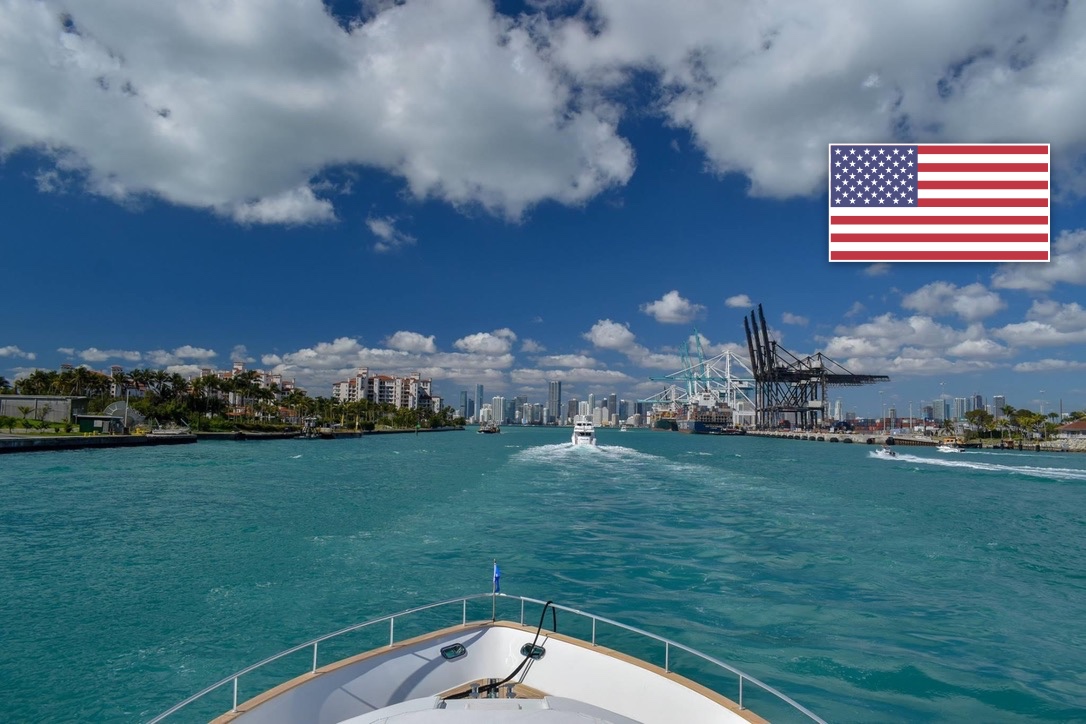
Entering and Departing the USA by Vessel
What a private vessel must do on arrival from a foreign port, what failing to report actually costs, what CBP ROAM does and does not cover, who can hold a cruising licence, and what you may bring home.
What a private vessel has to do on arrival from a foreign port, what it costs to get wrong, what ROAM does and does not cover, who can get a cruising licence, and what you may bring home.
You report immediately. Not the next morning.
Under 19 CFR 4.2 the master of a vessel arriving in the United States from a foreign port must immediately report that arrival, by any means of communication, to the nearest CBP facility or other location designated by the port director. The same applies to any vessel that has met a hovering vessel or taken merchandise aboard outside the territorial sea. Immediately means immediately. It is not satisfied by clearing in when the office opens.
What failing to report actually costs
This is the part left out of most guides, and it is the reason the word immediately is worth taking seriously. Under 19 USC 1436 the statute provides for:
- A civil penalty of $5,000 for a first violation and $10,000 for each subsequent violation
- A criminal fine of up to $2,000 or imprisonment for one year, or both
- Where prohibited merchandise is involved, an additional fine of up to $10,000 or up to five years
- And the one that matters most: any conveyance used in connection with the violation is subject to seizure and forfeiture
The conveyance is the boat. A failure to report is not a ticket, it is a provision under which the vessel can be taken. Those are the statutory figures and civil penalties are adjusted over time, so treat them as the shape of the exposure rather than an invoice.
ROAM, and where it stops
CBP ROAM is a free app that lets you report arrival from a phone. You enter biographical, vessel and trip details, a CBP officer reviews them, and you get the admissibility decision back as a push notification and an email. It needs a free login.gov account, so set that up before you leave rather than at the dock with one bar of signal.
In most cases ROAM satisfies the face to face inspection requirement under 8 CFR 235.1. It does not cover everything, and these are the two that catch people:
- Anyone aboard who needs an I-94
- Anyone who owes duty on goods brought in
In either case you are reporting in person at a Port of Entry, so it is worth knowing before you arrive which of those applies to your crew and what you bought while you were away.
Since September 15, 2021, ROAM also handles cruising licences, both applying for one and updating it, and reporting a domestic port arrival.
The $25 nobody remembers
Documented or registered vessels 30 feet in length or greater pay an annual user fee of $25.00, due at or before the first arrival in each calendar year. Two exemptions:
- Vessels under 30 feet
- Vessels holding a cruising licence under 19 CFR 4.94, for the term of that licence
It is a small sum and an avoidable irritation. Buy the decal before the season rather than explaining yourself on arrival.
The cruising licence, and who can have one
A cruising licence lets a foreign flagged pleasure vessel arrive, depart and cruise in United States waters, in the words of the regulation, "without entering and clearing, without filing manifests and obtaining or delivering permits to proceed, and without the payment of entrance and clearance fees, or fees for receiving manifests and granting permits to proceed, duty on tonnage, tonnage tax, or light money." In plain terms: you clear in once instead of at every port.
It runs for a stated period not to exceed one year. It is granted on reciprocity, so it is available only to yachts of countries that extend the same courtesy to United States yachts. Those named in 19 CFR 4.94 are Argentina, Australia, Austria, Bahama Islands, Belgium, Bermuda, Canada, Denmark, Finland, France, Germany (Federal Republic of), Greece, Honduras, Ireland, Italy, Jamaica, Liberia, Marshall Islands, Netherlands, New Zealand, Norway, Saint Kitts and Nevis, Saint Vincent and the Grenadines, Sweden, Switzerland, Turkey, and the United Kingdom with its Dependencies (Anguilla, Isle of Man, British Virgin Islands, Cayman Islands, Turks and Caicos Islands).
Two of those matter here more than the rest. Bahama Islands is on the list, which is directly relevant to anyone crossing both ways, and so are the Cayman Islands and the Marshall Islands, which is where a great many larger yachts are registered. A United States flagged boat does not need one and cannot have one. This is a foreign flag question, and if you are weighing a flag in the first place, the three routes are set out on where to register her.
Taking firearms out, and getting them back
If there is a firearm aboard, the work happens before you leave Florida, not on your return. Complete CBP Form 4457, the Certificate of Registration for Personal Effects Taken Abroad, and present the firearms and ammunition to a CBP officer for inspection while you are still in the United States. On re-entry you hand the completed 4457 back, along with any unused ammunition.
That form is what proves the guns were yours before you left. Without it you are trying to establish prior possession of a firearm at a border, after the fact, which is not a conversation anybody wants. It also dovetails with the Bahamas side: 4457 in Fort Lauderdale, declare within forty eight hours on arrival, keep everything locked and aboard, present the 4457 coming home.
And CBP is explicit that the form only works in one direction. In their words, "the Form 4457 is only for reentry into the U.S.; it is not an entry document to the importing country." It gets your firearms home. It does nothing at all to get them into the Bahamas, and the thing that does is the forty eight hour declaration under section 43(4), set out on our Bahamas page. Anybody who thinks the 4457 covers both ends has a problem on arrival at Bimini rather than on the way back.
What you may bring home, and the one that surprises everybody
Coming back into Florida with fish aboard is more regulated than the trip out. Florida Fish and Wildlife sets it out clearly.
- Finfish. Only dolphin, wahoo and reef fish may come back as fillets, and the skin must remain on the entire fillet. Two fillets count as one fish toward the bag limit, however long each one is
- Limits and seasons. South Atlantic federal single day vessel limits, per person bag limits and seasons all apply
- Transit. Passage through United States waters must be direct and continuous, with fishing gear stowed and terminal gear disconnected and stored separately
- Spiny lobster. The Bahamas lets you tail them. Florida does not: on return the lobster must be whole, head and tail intact. Permitted only in the regular recreational season, August 6 to March 31, and not during the two day sport season
- Nothing may be sold, and federal inspection applies at the port of entry
And conch cannot come home on the boat. Queen conch may only be transported from the Bahamas by aeroplane, and only for personal consumption. It is CITES Appendix II listed, and harvest in Florida waters and adjacent federal waters has been banned since the mid 1980s. This one catches people every season, because buying conch in the Bahamas is completely normal and bringing it back in your freezer is not.
Separately from the vessel rule, the United States prohibits import of queen conch in any form from Grenada and Haiti. That is a different restriction with a different basis and it does not apply to the Bahamas, but it is worth knowing if a boat is coming up through the islands.
On the agricultural side the general rule is simple enough: leave fresh fruit and vegetables behind, and fresh, dried or canned meat and meat products may not be imported from most countries, including things made with meat such as soup and bouillon mixes.
Frequently asked questions
When do I have to report arrival in the United States by boat?
Immediately on arrival from a foreign port, under 19 CFR 4.2, by any means of communication, to the nearest CBP facility. It is not satisfied by waiting until a CBP office opens.
Can I clear into the United States with the CBP ROAM app?
Usually yes. ROAM satisfies the face to face inspection requirement in most cases. Two exceptions send you to a Port of Entry in person: anyone aboard who needs an I-94, and anyone who owes duty on goods brought in.
How much is the CBP annual user fee for a boat?
$25.00 a year for documented or registered vessels 30 feet or longer, due at or before the first arrival each calendar year. Boats under 30 feet are exempt, and so is a vessel holding a cruising licence, for the term of that licence.
Can a US flagged yacht get a cruising licence?
No. A cruising licence under 19 CFR 4.94 is for foreign flagged pleasure vessels from a country on the reciprocity list, and it runs for a stated period of up to one year.
Can I bring conch back from the Bahamas on my boat?
No. Queen conch may only be brought from the Bahamas by aeroplane, for personal consumption. It is CITES Appendix II listed.
Sources: CBP ROAM; CBP pleasure boat user fee guidance; 19 CFR 4.2; 19 USC 1436; 19 CFR 4.94, corroborated against the GPO text; CBP prohibited and restricted items; Florida Fish and Wildlife, bringing fish back from the Bahamas; US Fish and Wildlife Service queen conch factsheet. Checked September 28, 2026 and re-verified against all of these on October 1, 2026.