
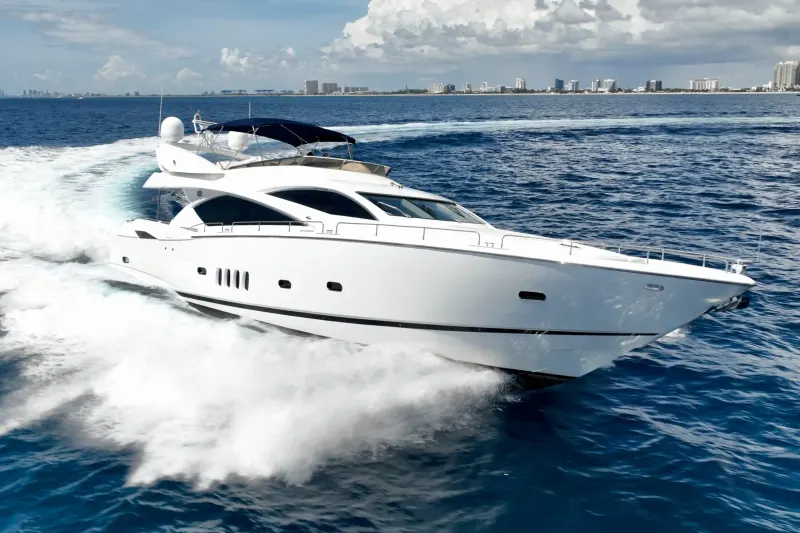
Your first motor yacht: Azimut, Princess or Sunseeker, and what actually decides it
Azimut, Princess or Sunseeker, how they differ, and the four questions that decide it before the badge does. Flybridge or sport yacht, pods or shafts.
By John Booysen, CPYB
Yacht broker in Fort Lauderdale since 2000Updated
A first motor yacht is usually shopped as a three way comparison, and it is usually the same three. They are the European builders with the deepest presence in the United States, they overlap heavily on size and price, and a buyer can walk all three at one boat show. That is exactly why the comparison rarely settles anything on its own.
If you are weighing the size rather than the badge, start with how to choose the right yacht, which works from the nights you will spend aboard rather than from a length. This page is about the boats themselves.
The three, as they actually differ
Azimut leads with styling and with volume. The Italian yards have been more willing than most to push beam, glass and layout, and a buyer comparing on paper often finds an Azimut gives more usable interior at a given length than her rivals. The interiors are designed rather than merely fitted, which is a real attraction and is also the first thing that dates.
Princess is the conservative of the three in the sense that a naval architect would use the word. The British boats have a long reputation for the way they behave in a sea, and the finish tends to be judged by joinery rather than by drama. Buyers who intend to run the boat themselves, in weather, often end up here.
Sunseeker sits between the two and pushes performance and profile harder. The brand presence in South Florida is strong, which matters more than it sounds: it affects how easy the boat is to service, how many comparable sales exist when you come to sell, and how quickly a broker can tell you what she is worth.
Those are characters, not rankings. At any given size and year, the specific boat in front of you decides it. We have a worked comparison at the larger end, Sunseeker 82 against Azimut 80 Carat and Princess 85, which is worth reading if your first boat is going to be a big one.
The four questions that decide it first
Who drives her. A boat you will run yourself and a boat with a captain are different purchases at the same length. Dock handling, sightlines from the helm, and how much systems maintenance you are prepared to do yourself all move to the top of the list if the answer is you.
Flybridge or sport yacht. A flybridge gives you a second helm, shade and a place for everyone to sit; a sport yacht gives you a cleaner profile and usually a better turn of speed. In South Florida the flybridge wins for most owners who entertain, and loses for owners who care about bridge clearance on the Intracoastal.
Pods or shafts. This is the question that generates the most argument and the least clarity. Pod drives make close quarters handling dramatically easier, which for a first boat is not a small thing. Shafts are simpler, cheaper to maintain over a long ownership, and more forgiving of a grounding. Our size guide goes through it in more detail.
Where she will live. The slip decides the length long before the broker does, and in Fort Lauderdale it frequently decides the beam too. Settle the dockage before you fall in love with a specific boat.
What to check on a first boat in particular
The usual survey and sea trial apply, and our survey guide covers how both work. Three things catch first time buyers specifically.
Service records, not hours. A low hour boat with no records is a worse buy than a higher hour boat with a folder. On these builders the systems are the expensive part, and the systems tell their story in paperwork.
What transfers and what does not. On a newer boat, warranty position, electronics subscriptions and any yard work in progress are all separate questions from the boat herself. Ask them early, because the answers occasionally change the price.
The stabilizer question. Fin or gyro, fitted or not fitted, is one of the few options that genuinely changes how often the boat gets used. Retrofitting is possible and is rarely cheap, so it belongs in the shortlist criteria rather than in the wish list.
What she will cost to keep
Our cost of ownership guide sets out dockage, insurance, fuel, maintenance and crew by length at South Florida rates, with worked annual totals. For a first boat the two lines that surprise people are insurance, which is priced partly on your experience rather than only on the boat, and the repair fund, which is the line most first budgets leave out entirely.
Financing is a specialist business and we do not give financing advice. If you want a lender, we will refer you to a yacht financing specialist who does this for a living. Our page on how to finance a yacht sets out how the process usually runs.
To see what is actually on the market, the Fort Lauderdale pages are split by length: 40 to 60 feet and 60 to 80 feet cover the sizes most first motor yachts fall into.
Frequently asked questions
Is Azimut, Princess or Sunseeker better for a first motor yacht?
None of the three is better in general. Azimut tends to give the most interior volume and the boldest styling, Princess has the strongest reputation for sea keeping and joinery, and Sunseeker sits between them with a sportier profile and a strong service presence in South Florida. At a given size and year the individual boat, her specification and her maintenance history decide it.
What size should a first motor yacht be?
Work from the nights you expect to spend aboard, the water you want to cross and what you are prepared to spend keeping her, and the length answers itself. Our guide to choosing the right yacht sets out what each length band carries, what crew she needs and what she costs to run.
Are pod drives or shafts better for a first boat?
Pods make docking much easier, which matters a great deal if you are running her yourself. Shafts are simpler, cost less to maintain over a long ownership and are more forgiving of a grounding. For a first boat that will be owner driven in a tight marina, pods are worth the premium for most buyers.
Should I buy new or pre owned for a first yacht?
A pre owned boat two to five years old has taken the steepest part of the depreciation and still carries current systems. A new boat gives you the specification you want and a warranty. The deciding factor is usually how particular you are about layout and finish, because that is the thing a pre owned market cannot be made to supply on demand.
Do I need a captain for a 50 to 70 foot motor yacht?
Many owners at this size run the boat themselves and bring a captain in for longer passages or for guests. Above roughly 70 feet a full time captain becomes usual. Our cost of ownership guide gives the crewing expectation for each length band.